IPM Radio Review: Definitive Technology W7 Speaker
It’s no secret that I have a soft spot for products that deliver bigger bang for the buck. There’s just something about having a device or gadget perform more than what one might expect. And that’s why I decided to do this Definitive Technology W7 speaker review as I think it’s a GREAT bargain for those looking for sweet sound at a sweeter price.
Design & Connectivity
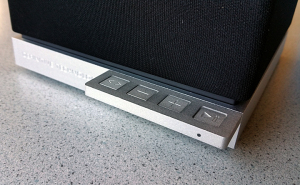
The Definitive Technology W7 speaker is an innocuous looking cube with an aluminum base, making it appear as if the speaker’s special resting place is separate. The audio input, volume, and play/pause buttons that jut out the front help to create this illusion of a completely separate base. But it’s all one piece. I rather like it. The switch button toggles through the inputs, and it’s accompanied by a separate LED that glows from underneath the speaker covering.
The speaker has got some pretty good weight to it! Take care, since the weight isn’t evenly distributed. Don’t drop it or tear the covering.

The top is glossy – fingers off. I almost wish I didn’t remove the plastic film, since the top is very sensitive to edges. There’s a few permanent scratches, the kind that only shows up if you’re looking at the right angle. But, still. Darn it. The fabric covering the trio of speakers is appropriately taut with no loose edges or frays.
The rear contains the ports for power, Ethernet, optical, and auxiliary. The Wi-Fi Setup button is there too, all that. You know, the boring stuff. Don’t be fooled by the USB port in the back. That’s only for firmware updates.
As for the guts, you have a brace of bass radiators to each side of the W7 speaker, a combo mid/bass driver in the front, and a total of four tweeters to pump out sound. The only side without speaker business is the back, so make sure that it points to some wall. Basically, you’ve got an efficient box of speakers with nothing extra or unnecessary. Gotta respect it.
For not being a ‘portable (i.e. contains an internal rechargeable battery) speaker’, the Definitive Technology W7 is pretty portable! When you need to move it, it carries in one hand relatively well. And your only real limitation is reaching the nearest outlet. You probably could put it in a backpack if you really wanted to. I doubt it would be comfortable for long, but yes it can be done!
Definitive Technology Play-Fi app
If you want to listen to music wirelessly and/or set up multiple Definitive Technology products together, you’ll have to download their app. It provides easy steps for connecting the speakers to your home network. All wireless, no audio loss to worry about.
Adding the W7 speaker via WPS didn’t work for me, which wasn’t a surprise.. I blame my router for that – it’s always been the common denominator for such issues. But the standard set-up worked fine, and I also chose the ‘update software’ option presented to me. The last things to do is choose a name for the speaker, then you’re off to play some music.
 Navigating through all your music feels similar to many other apps out there. In some ways the Definitive Technology Play-Fi app is a little vanilla, but it’s effective at letting you find what you want by song, artist, albums, playlist, genres, podcasts. You can even tune into local broadcast radio stations as well as internet radio. Album cover art is shown (when applicable), and music starts up in a couple of seconds from hitting play.
The volume slider in the app is directly tied to the W7 speaker. It’s also completely separate from the levels of your connected device. This means that the only way to change the W7’s volume is by pressing its buttons or using the app. All those other mobile noises – system notifications, games, videos, whatever – emit from the device itself.
When you have more than one Play-Fi compatible speaker, you can group them up together. (The yellow triangle at the bottom right of the app is what to hit.) You get to see each connected speaker and even rename them. Speakers can be assigned to only one (at a time) of the four zones. If you happen to own two speakers, the app lets you pair them in stereo for left and right channels. This is probably my favorite feature right here.
Two words: perfectly synced. The only adjusting you might do is balancing the audio versus the listening distance to each.
Overall, this Definitive Technology Play-Fi app is pretty decent, but there are some elements that need serious improvement. The process of putting speakers into groups and zones is way too involving and clumsy. It should be easier for users to command the audio playing in separate zones from the single device. Adding equalizer controls to the Play-Fi app wouldn’t hurt either.
When smartphone and/or network router hiccup (momentarily disconnects) the Play-Fi app rarely ever lets me resume where was at last. This is annoying to me. Also, the app doesn’t really like when I try to jump the cursor to a certain point in a song. The track sound stops, although it still may be playing, and the cursor moves all the way to the end as if it were done.
Audio Quality
Despite being half the size of a shoebox, the Definitive Technology W7 speaker belts out with some excellent projection. You don’t even need to turn it up all the way in order to completely fill a room – doing so ends up blanketing the adjoining rooms as well.
 You can turn the W7’s volume all the way past 80 percent of max, and the worst you’re going to hear is a bit of harshness/brightening of vocals and highs.
Maybe some of the mids strain a little bit. However, standing back by at least 10 feet mellows out some of this effect. But the best volume level also depends on genre and track recording. Overall, I’ve been able to play most everything comfortably all the way up to 80 percent of max volume.
In some instances, I’ve turned it up all the way and everything still sounds great. But the W7 speaker doesn’t develop noise, distortion, or overblown lows, like what can be common with the vast majority of speakers under the $500 price point.
As for volume, the Definitive Technology W7 speaker delivers higher levels of volume when music plays wirelessly (through the app) instead of by an auxiliary cable. Just in case you were wondering. And no, it doesn’t really work well as a TV soundbar.
Once in awhile, when you have the volume over 70 percent (roughly) and a song takes off with a crescendo, you’ll notice a momentary recession in the output. It’s very brief, yet it’s there, especially if you know your music well. With Zach Hemsey’s “Mind Heist” as an example, the track positions of 1:05 and 1:26 are like celestial geysers of intense sound and emotion. It is at those precise points (among others) that the W7’s compressors kick in to pull the speakers back just a touch. This way, the hardware won’t suffer from duress just because you love to listen to your music loud. It’s smart, and I love it.
Although music from the W7 speaker can envelop a room (or two) with audio, there’s not that much sense of lateral imaging. Consider it a mono speaker, more or less. However, thanks to the W7 features and design, music sounds the same no matter where you are in the room. Every spot is a sweet spot with volume that dissipates evenly through distance. Just hook it up to your best streaming media player and rock on!
Despite the lack of distinct sides to the soundstage, you can still hear width and depth of individual instruments. Elements are represented with clear and defined focus. Each note belongs to its respective instrument with minimal blending (if that) with anything else. Trust that this alone should be more than enough to make you forget about the lateral imaging. If not, well, get a second unit and pair them in stereo with the app to get the desired dimension. You’ll find a way to deserve it for yourself *wink*
 When it comes to equilibrium, the Definitive Technology W7 speaker is absolutely fantastic. The highs, mids, and lows combine together to present vocals and instruments with wonderful balance. Nothing seems to crowd out anything else as projection and richness are doled out in equal measure.
I, personally, don’t mind forward vocals that reach out to pull you in. But I can’t stand the recessed kind. The W7 hits a sweet spot of smoothness by not over-emphasizing any particular element. And even though the music comes out forward from the speaker, it’s not so aggressive and in-your-face like the ZVOX sound bar I reviewed earlier.
A word of warning – expect your variable bitrate MP3s (e.g. ones from Amazon) to sound like garbage. Expect to hear constant peaks and dips throughout the entire track, all in the same places particular to each individual song. Vocals can sound like the artist is in a hallway, being pushed back and forth by two bullies. And if it happens during a favorite moment of your favorite song, it’s like awaiting relief from a sneeze only to have it go away instead. In and out. That’s right, variable bitrate MP3s are the musical equivalent of bathroom turtle heads.
It has nothing to do with wireless, you’ll hear the same by playing through an audio cable to the W7 speaker. And just to be certain, I compared the variable bitrate MP3s I downloaded from Amazon to the 256kbps MP3s I created from the physical CD that came with the purchase. You don’t even need to be an audiophile to hear the difference – my nine-year-olds were able to point out the difference.
While these variable bitrate MP3s may sound perfectly fine on most speakers under the $400 mark, the Definitive Technology W7 has enough detail and precision to underscore your mistake in buying the digital album only. Should have spring the extra cash for the CD with digital download. And I’ll be the first to admit having done this half a dozen times. Thankfully, the bulk of my music collection is all in FLAC format, created from my CDs. (Don’t blame speakers, it’s about the source files too.)
And, just to be clear, not all of my variable bitrate MP3 albums experienced this. But most did.
The Definitive Technology W7 speaker is truly amazing when you consider how well it maintains quality at such a small size. I keep mentioning the size – can’t get over it! It’s impressive. Even at maximum volume, I can enjoy the powerful swell of voices of the Westminster Cathedral Choir without flinching. Though sharpening at the peaks may be rare, rolled-off highs are practically nonexistent. Many other speakers – few in similar price yet many in similar size range – tend to let the upper register of highs hit a ceiling. As you listen to the smooth crescendo of voices, you can hear how the W7 maintains an open atmosphere.
 The sounds of cymbals are absolutely delicious. Now, I’m the kind of guy that loves music enough to overlook tinny highs and sizzle on cymbals. Sometimes even suffer through it if I like the speaker enough.
But with the W7, it doesn’t matter if it’s a tap, hit, or brush. Hi-hats and cymbals preserve their metallic timbre and sound as they should. They blend in with the rest of the song and tend to add to the impression of stage depth.
Vocals maintain silky smoothness, even as they arc up into the higher registers. It’s wonderful to pick out characteristic inflections within sung lyrics. The W7 captures such subtle dynamics, presenting the full emotion to the listener for personal enjoyment. Lesser speakers tend to simplify or gloss over all of this. Just remember to keep the volume in check, since some songs tend to bleach the highs when there is too much.
I love how the vocals sound completely separate from the instruments, yet aren’t detached or too forward on the stage. It doesn’t matter if vocals consist of one or more singers. This is really important to me when I listen to metal, since lead guitar (or guitars) can be as big (or bigger) or aggressive (or even more aggressive) than the lead singer. Sometimes you’ll get a speaker that lets some instruments drag down or colorize the vocals. Not here. The W7 speaker takes Kamelot’s song, “Across the Highlands”, off of their Karma album, and sonically paints it with epic majesty.
You get some great guitars out of the W7, too. The tone of strings are spot on, and you can practically close your eyes and imagine the instrument and player just meters in front of you. “I Can Learn” by The White Stripes delivers a thumping mix of bass, drum, and guitar at varying volumes. The individual vibrancy and intensity of each is not lost upon the listener.
It’s not just the clarity and separation of instruments that get you going. There is a lot of energy streaming through the mids, carrying copious amounts of excitement no matter the genre of music. Of course, considerable energy comes from the highs and lows too, but the mids have the plurality. If someone plays Jamoirquai’s “Canned Heat” and you don’t boogie with it, you might be in a full-body cast.
 Those who want overemphasized lows won’t find them here. The W7 maintains a balance throughout, choosing to focus on quality instead of big booty. I always appreciate this, since it’s not difficult to use an equalizer to enhance my music. There is a lot of musicality that goes on in the lows, and this speaker lets you hear all of it. Mid- and sub-bass texture? That’s all here too.
Do you like purring bass? I like purring bass. And the W7 purrs. Listen to the song “Long Nights” by Eddie Vedder, off the Into the Wild soundtrack. You can practically feel the string vibrations. While the overall sense of stage may not be wide, you certainly get the depth of it all with the low-end action. But the best part is that you can still hear and focus on the mids and highs. The lows shine but don’t steal the spotlight.
Although the W7 speaker may be small, it’s mighty. Referring back to the “Mind Heist” song by Zach Hemsey – it delivers some seriously sudden power in the lows. Sure, it may not be able to carry the vibrations that a hefty floor subwoofer can. But the W7 maintains technical agility with punchy, expressive drums and bass. You are not going to get bloated tones here, which is preferable to anyone who wants to hear each bit of note.
I’m sure that some listeners might comment about a lack of bass force (at some point or another). I’m preemptively (and politely) disagreeing with such statements. The low-end power that comes from the W7 is very impressive, completely betraying the compact speaker size. I think it’s plenty big enough, and anyone wanting more can simply pair another Definitive Technology product to enhance. Besides, quality beats quantity in my cookie jars, and the W7 has hands in both.
If I had to pick what stands out to me the most about the W7’s lows, it would be the exceptional decay. The attack of drum hits (for example) are fantastic, but it’s the decay that really gets me going. The beats come defined and detailed, as opposed to sounding a little bloated on the back half. I’m talking clean, but without any sacrifice to the muscularity of what you get up front.
Verdict
It’s quite possible that the Definitive Technology W7 speaker is in a league of its own. The music that comes out of it is incredibly vibrant and energetic. The energy isn’t just in the mids. It’s all across the board. And I absolutely love the balance, knowing full and well I can always fire up an equalizer to tweak things however I like. But right out of the box, the W7 speaker does justice to all of your favorite music and artists.
The weakest part about listening to the Definitive Technology W7 speaker is using the Play-Fi app. It’s only ‘ok’ when you have a single speaker, though there are a few things that need to be tweaked. But if you are using more than one Definitive Technology device at a time, especially in separate zones, the app forces too many screens and choices. The average consumer likely doesn’t have the level of patience and disregard that I do.
Anyone who wants stereo sound from Definitive Technology need only buy a second speaker. Tall order? Maybe. But once you hear one W7, it’s going to be hard to not want another. Totally serious. Besides, linking a brace of speakers is easily done with the Play-Fi app.
Now, it’s not just the audio quality that makes the W7 so awesome. Take the size and price into consideration; this is definitely a serious contender. Those who live in smaller spaces can appreciate portability without having to sacrifice sound quality. The W7’s volume can handle larger spaces across multiple areas, too. Either way, this speaker is gonna grab your attention and hold it. I’m a fan.